By Katherine K. Chan and Sheldeen Joy Talavera, Reporters
THE ASIAN Development Bank (ADB) is looking to cut its growth forecast for the Philippines amid risks from the escalating war in the Middle East and the lingering effects of the flood control graft mess last year.
ADB Lead Economist for Southeast Asia James P. Villafuerte said they will likely revise their initial estimate of 5.3% Philippine gross domestic product (GDP) growth for this year to account for the impact of the Middle East war on inflation, remittances and tourism.
“We are revisiting the number because of this new Middle East conflict, which will certainly affect our growth forecast,” he told reporters at a briefing in Taguig City on Thursday. “We are also tracking the progress in terms of the corruption scandal, which has affected confidence in investment flows.”
The ADB’s current 5.3% growth forecast for 2026 is still faster than the 4.4% expansion in 2025 when slow investments as well as household and government spending due to governance issues from the flood control corruption scandal took a toll on the economy.
The projection likewise falls within the Development Budget Coordination Committee’s 5%-6% target for the year.
ADB Chief Economist Albert Park said the ongoing war in the Middle East may have already trimmed 0.1% off of Southeast Asia’s GDP growth.
He added that the Philippines would see a similar degree of growth impact if the war lasts only around a month.
Meanwhile, Mr. Park said oil shocks may drive inflation to pick up about half a percentage point by yearend.
“Given how important energy is in the consumer basket of many consumers in the region, even if the war ended today, I think we would see higher inflation this year by about half a percentage point relative to what it would have been without any conflict,” he said.
Still, he noted that this remains manageable as most inflation prints in the region, including the Philippines, remain well within the central banks’ target range.
Headline inflation has accelerated since December last year and has settled within the Bangko Sentral ng Pilipinas’ (BSP) 2%-4% target for two straight months.
In February, higher oil prices pushed up inflation to 2.4%, the fastest in over a year.
Mr. Villafuerte noted that the Philippines may see a similar inflationary impact seen in late 2022 or when Russia’s invasion of Ukraine jolted global oil markets if the Middle East war lasts as long as the former.
Inflation accelerated to as much as 8.1% in December 2022, bringing the full-year average inflation to 5.8% before picking up further to 6% in 2023.
“So, I think there’s actually a good comparator if this conflict becomes a bit prolonged and the price of oil stays above $100, I think that kind of impact of inflation might be felt by the Philippines,” Mr. Villafuerte said.
Asked if the looming risks raise the possibility of stagflation, the ADB economists said it may be “too early to speculate,” noting that the current situation remains a short-term supply shock.
“I think it would have to be quite prolonged. I mean, yes, in principle, the war is causing slower growth and higher inflation, but I’m not sure that means stagflation, which is often like recession. So again, I think it would depend on the duration,” Mr. Park said.
DIESEL AT P100 PER LITER?
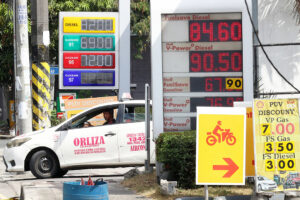
Meanwhile, some oil firms are still mulling whether to stagger the implementation of another potential double-digit hike in pump prices this week, which could push diesel above P100 per liter.
“We’re aligned with the advisory of the DoE (Department of Energy) and are prepared to support a staggered implementation just as we did last week,” Brigitte Carmel C. Lim, senior vice-president and chief operating officer of Cebu-based Top Line Business Development Corp., told BusinessWorld.
Ms. Lim said that while there is an upward pressure in fuel prices due to continuing geopolitical developments, it is still early to confirm the final adjustment.
Independent oil firm Jetti Petroleum, Inc. is still assessing how to implement the price adjustment for this week.
“We may be implementing the increase one-time. Or probably in two tranches. Nothing final as of now,” Jetti President Leo P. Bellas said.
An industry source told BusinessWorld that diesel prices may increase by P18 per liter starting March 17. Gasoline prices, on the other hand, may jump P12 per liter.
The estimates were based on the five-day trading on the Mean of Platts Singapore, a benchmark used for refined oil products.
The intensifying conflict among Israel, United States, and Iran has paralyzed maritime traffic through the Strait of Hormuz, which has “severely disrupted supply chain due to the loss of crude feedstock from the Middle East,” the source said.
As a result, some refineries have closed or run cuts, as well as lead to force majeure within Asia, given the region’s heavy dependence on supply from the Gulf, the source added.
Last week, the Philippines had its highest single-week adjustment as kerosene price ballooned to as much as P38.50 per liter. Some oil companies heeded the government’s call to stagger big-time price adjustments by implementing the increases in two to seven tranches.
Top Line’s Ms. Lim said the company continues to offer programs that help customers and transport partners manage costs, such as per-liter discounts and priority fueling access.
IBON Foundation Executive Director Jose Enrique “Sonny” A. Africa said that revisiting the Republic Act No. 8479, or the Downstream Oil Industry Deregulation Act is “immensely justified,” given that the country has had nearly three decades of overdependence on oil and imports.
Enacted in 1998, the law allows oil companies to set and adjust pump prices based on global oil prices and other market factors, instead of awaiting government approval.
“The very premise of deregulation of such a strategic commodity with such far-reaching impact has to be overturned, the law repealed, and a new law regulating the oil industry enacted,” he told BusinessWorld.
Mr. Africa said that the government has to be given powers to make pricing transparent.
“Oil firms should disclose its import prices, freight and storage expenses, refining and blending costs, inventory costs, wholesale and retail margins, and any transfer pricing to the government and the public,” he said.
REMITTANCES, TOURISM AT RISK
Meanwhile, Mr. Villafuerte said the Middle East conflict, especially if prolonged, also poses threats to remittances and tourism in the Philippines.
“So, my worry is if this really gets prolonged and Filipino workers in the Middle East are affected, that would have an impact on remittances. Although historically, remittances have been very robust,” he added.
According to the National Government, over 2.4 million Filipino migrants and laborers are based in the Middle East.
BSP data also showed that OFW remittances rose by 3.3% year on year to hit a record high of $35.634 billion in 2025, with 18.19% or $6.481 billion sent home from the Middle East.
Mr. Villafuerte said homebound OFWs from the Middle East bringing their earnings back to the country could drive a short-term increase in remittance inflows but noted that repatriation could have some negative impact in the long run.
For this year, the BSP expects remittances to climb by 3% to $36.6 billion.
previous post
