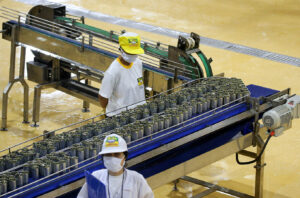
Manufacturing output eased to a two-month low in January dragged by contractions in food and transport equipment as well as sluggish growth in other non-metallic mineral products, the Philippine Statistics Authority (PSA) reported on Friday.
Preliminary results of the PSA’s latest Monthly Integrated Survey of Selected Industries (MISSI) showed factory output, as measured by the volume of production index, slowed by 1.2% year on year in January.
This was slower than the 3.2% growth in January 2025 and the revised 2% increase recorded last December.
It was also the weakest growth in two months or since the 0.6% uptick in November last year.
The sector’s output has been in positive territory for nine straight months.
Month on month, January’s output grew by 4.7%, from a 3.6% decline in December. Stripping out seasonal factors, it inched up by 2.8% from 1.1%.
In comparison, the Philippines in S&P Global Manufacturing Purchasing Managers’ Index (PMI) expanded 52.9 in January from 50.2 in December. It was the fastest pace in nine months or since the 53 expansion logged in April 2025.
PMIs are a leading indicator for factory activity, reflecting the volume of materials purchased in advance of manufacturing operations weeks or months down the line. A reading above 50 separates expansion from contraction.
Marco Antonio C. Agonia, an economist at the University of Asia and the Pacific, said that the slip in manufacturing activity points to the “muddling through” narrative of 2026.
“While we expect economic activity to slightly recover this year, the absence of concerted efforts to restore business confidence and improve business operations appears to continue weighing on industrial activity,” he said in an e-mail.
Data from the Bangko Sentral ng Pilipinas’ inaugural monthly business expectations survey (BES) showed that businesses had a current-month confidence index (CI) of 0.9% in January.
While the positive value indicated business optimism, the figure was a crash from the quarterly CI of 29.7% seen in the fourth quarter of 2025.
Rizal Commercial Banking Corp. Chief Economist Michael L. Ricafort said that the industrial production slowdown in January is largely attributed to political scandal last year that curbed infrastructure spending, with anti-corruption reforms dampening demand across supply chains and weighing down on manufacturers.
“Higher tariffs could have weighed on global trade, adversely affecting manufacturers that are part of the global supply chains of exporters,” Mr. Ricafort said in an e-mail.
In a phone interview, Philippine Chamber of Commerce and Industry Honorary Chairman Sergio R. Ortiz-Luis, Jr. said that business uncertainty caused by further potential US tariffs contributed to the slip.
According to the PSA, the slowdown in factory output in January was due to the sharp annual declines in the heavily weighted food index.
Food manufacturing’s VoPI dipped by 0.5% in January from the 14.9% growth in December and a reversal from the revised 15.5% growth a year earlier.
The food products index accounted for 18.7% of manufacturing activity.
Meanwhile, slowdowns were recorded in other non-metallic mineral products (6.8% in January from 32.4%in December), and transport equipment (-1.9% from 5.8%).
Eight other divisions logged declines while the remaining 11 posted expansion.
Additionally, the PSA said that the top three industry divisions that contributed to the overall year-on-year growth in the VoPI were computer, electronic and optical products (23.6% from 14.1%), beverages (21.1% from 4.8%), and electrical equipment (16.7% from 11.4%).
Mr. Agonia said that the sudden plunge in food manufacturing growth may be attributed to seasonal adjustments and manufacturing conditions.
“Food manufacturers likely scaled down production after the holiday season, while cost pressures continue to build. We note that growth in the Producer Price Index (PPI) has been accelerating since November last year, largely driven by the food products segment,” he said.
Year on year, the PPI grew by 1.5% in January 2026, from the 0.9% posted in the same period last year, and the 0.8% in December, PSA data showed.
Its food subindex grew by 1.3%, higher than the 0.4% in January 2025 and reversing the 0.1% contraction last December.
For the following months, Mr. Agonia said that people are monitoring movements in global oil prices following conflict escalation in the Middle East.
“These higher oil prices are expected to raise production costs for most economic sectors, leading to deterioration in manufacturing conditions and higher retail prices.”
Mr. Ortiz-Luis said that that continued discussions with the US is necessary to improve factory outputs.
“It’s like we have no leverage with them. And [we’re pushing them to] define what exactly the applicable tariffs are,” he said.
Average capacity utilization — the extent industry resources are used in producing goods — averaged 77.8% in January, slightly higher from the 77.6% in December and 76.2% in January 2025.
All industry divisions reported capacity utilization rates above 60%, with coke and refined petroleum products reporting the highest rate at 84.5%. — Pierce Oel A. Montalvo